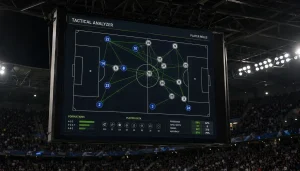
As we approach 2026, the tactical landscape of international football is undergoing a revolution driven by advanced analytics and real-time data processing. The days of relying solely on scouting reports and “gut feeling” are long gone. Today, national teams are essentially data-driven enterprises, utilizing every metric from expected goals (xG) to physical load tracking to gain a competitive edge in a tournament where one mistake can mean elimination.
The Rise of High-Intensity Systems
The modern game is defined by transitions. The most successful teams in recent years have mastered the art of “Gegenpressing” and rapid counter-attacks. This requires a level of physical conditioning that was unheard of a decade ago. Data allows sports scientists to tailor individual training regimes, ensuring that key players reach their peak fitness exactly when the group stage begins. We are seeing a shift away from slow, possession-based build-up toward more vertical, high-velocity football that exploits spaces in seconds.
This high-intensity approach isn’t just about running more; it’s about running smarter. Positional tracking data tells coaches exactly where the “packing” opportunities are—the moments when a single pass can bypass multiple defenders. Teams are now training specifically for “transition triggers,” recognizing the exact moment an opponent loses body shape or balance during a turnover. The result is a more explosive, unpredictable game that favors athletic versatility over rigid positioning.
Set-Piece Specialization
In tournament football, where margins are razor-thin, set-pieces have become a primary focus. Many top nations now employ dedicated set-piece coaches who use geometric modeling to design routines that exploit specific defensive weaknesses identified through thousands of hours of video analysis. The 2026 World Cup will likely see a record number of goals from dead-ball situations, as teams use data to maximize their efficiency in these controlled moments. From “blockers” creating space to intricate near-post flicks, every movement is choreographed to perfection.
Goalkeeping: The Eleventh Outfield Player
The role of the goalkeeper has evolved significantly. In 2026, we will see “sweeper-keepers” who are as comfortable with the ball at their feet as they are making saves. Tactical boards now incorporate the goalkeeper into the initial build-up phase, creating numerical superiorities that allow teams to bypass high presses. The ability to distribute accurately over long distances is now a non-negotiable requirement for elite-level keepers. Goalkeepers are now analyzed on their passing accuracy, their ability to break lines, and their sweeping range just as much as their shot-stopping metrics.
In-Game Adjustments and AI
The integration of real-time data on the bench is the next frontier. Coaches now have access to live heat maps and player connection charts during the match via tablets. This allows for immediate tactical shifts—adjusting the defensive line by five meters or swapping a winger to exploit a tired fullback. Artificial intelligence is being used to simulate thousands of match scenarios, helping coaching staffs prepare for every possible “what if” during the knockout rounds. AI models can now predict the likelihood of a goal occurring in the next 10 seconds based on current player positioning and ball velocity.
The Psychological Edge: Mental Performance Data
Beyond the physical and tactical, data is also being used to monitor player psychology. Stress levels, sleep quality, and cognitive load are tracked through wearable tech to ensure that players are mentally “fresh.” In the high-pressure environment of a World Cup penalty shootout, this mental data can be the difference between a trophy and a flight home. Teams are hiring performance psychologists to work alongside data analysts, creating a holistic view of the player’s readiness.